Pachrahi Archaeological & Heritage Site
Explore the ancient archaeological site of Pachrahi in Kabirdham on the Haph River. Excavated Kalachuri gold coins, 160-million-year-old Jurassic fossil, museum timings & driving distances from Raipur, Bilaspur & Durg.
Quick Facts & Overview
| Parameter | Details |
|---|---|
| Official Name | Pachrahi Archaeological Site |
| Category | Ancient Archaeology, Medieval Heritage & Site Museum |
| River Setting | Right bank of the Haph River, a perennial Maikal tributary |
| Excavating Agency | Directorate of Culture & Archaeology, Government of Chhattisgarh |
| Major Excavation Years | 2007 to 2011 (led by archaeologists S.S. Yadav, Dr. Bharati Shroti & Atul Pradhan) |
| Dominant Dynasties | Kalachuri of Ratanpur (11th–13th c.) & Phani Nagavanshi (11th–14th c.) |
| Oldest Discovery | 160-million-year-old fossilized marine mollusk/snail (Jurassic period) |
| Numismatic Treasure | 100+ Kalachuri royal gold, silver, and copper coins |
| Religious Harmony | Shaivite, Vaishnavite, Jain (Tirthankaras), and Buddhist antiquities |
| Distance from Kawardha | 45 km north via NH 30 through Bodla (~1 hour 10 mins drive) |
| On-Site Facility | Pachrahi Site Archaeological Museum (displaying sculptures, weapons & pottery) |
| Best Season to Visit | October to March (pleasant weather for outdoor archaeological exploration) |
Distance & Travel Route Matrix from Major Cities
Pachrahi is easily visited as a day trip from Kawardha, Raipur, Bilaspur, or Durg-Bhilai via well-maintained highways across the central plains of Chhattisgarh into Bodla block.
| Starting City | Distance | Travel Time | Recommended Highway Driving Route |
|---|---|---|---|
| Kawardha | 45 km | 1 hour 10 mins | NH 30 north: Kawardha → Bodla (30 km) → turn northwest onto Taregaon road → Pachrahi (15 km) |
| Bodla Town | 15 km | 25 mins | Paved rural state road connecting Bodla to Taregaon/Pachrahi along the Haph River |
| Raipur (State Capital / Airport RPR) | 170 km | 3.5 to 4 hours | NH 30 corridor: Raipur → Simga → Bemetara → Kawardha → Bodla → Pachrahi |
| Durg & Bhilai | 165 km | 3.5 to 4 hours | Via Bemetara: Durg/Bhilai → Nandghat → Bemetara → Kawardha → Bodla → Pachrahi |
| Bilaspur | 150 km | 3.5 hours | Scenic Route: Bilaspur → Mungeli → Setganga → Pandariya → Bodla → Pachrahi |
| Rajnandgaon | 155 km | 3.5 hours | Rajnandgaon → Khairagarh → Gandai → Kawardha → Bodla → Pachrahi |
| Bhoramdeo Temple | 35 km | 50 mins | Bhoramdeo → rural link road to Bodla → north to Pachrahi |
| Rani Dahra Waterfall | 18 km | 30 mins | Rani Dahra forest road → Bodla → Taregaon road → Pachrahi (ideal same-day pair) |
What Is Pachrahi? (The Name & Origin)
Locally known as Pachrahi or Sili Pachrahi, the site name translates to the "Crossroads of Five Pathways" (Panch-Rahi). For centuries before modern highways, this natural river bend served as an indispensable geographical gateway where five historic caravan and pilgrimage routes converged:
- The eastern royal route from Ratanpur (the historic Kalachuri imperial capital)
- The southern highway from Dhamtari and Kanker via the Kawardha plains
- The western mountain pass crossing the Maikal Range toward Mandla and the Narmada Valley
- The northwestern trade corridor heading into Jabalpur and Central India
- The local sacred pilgrim trail leading south toward the temples at Bhoramdeo and Madwa Mahal
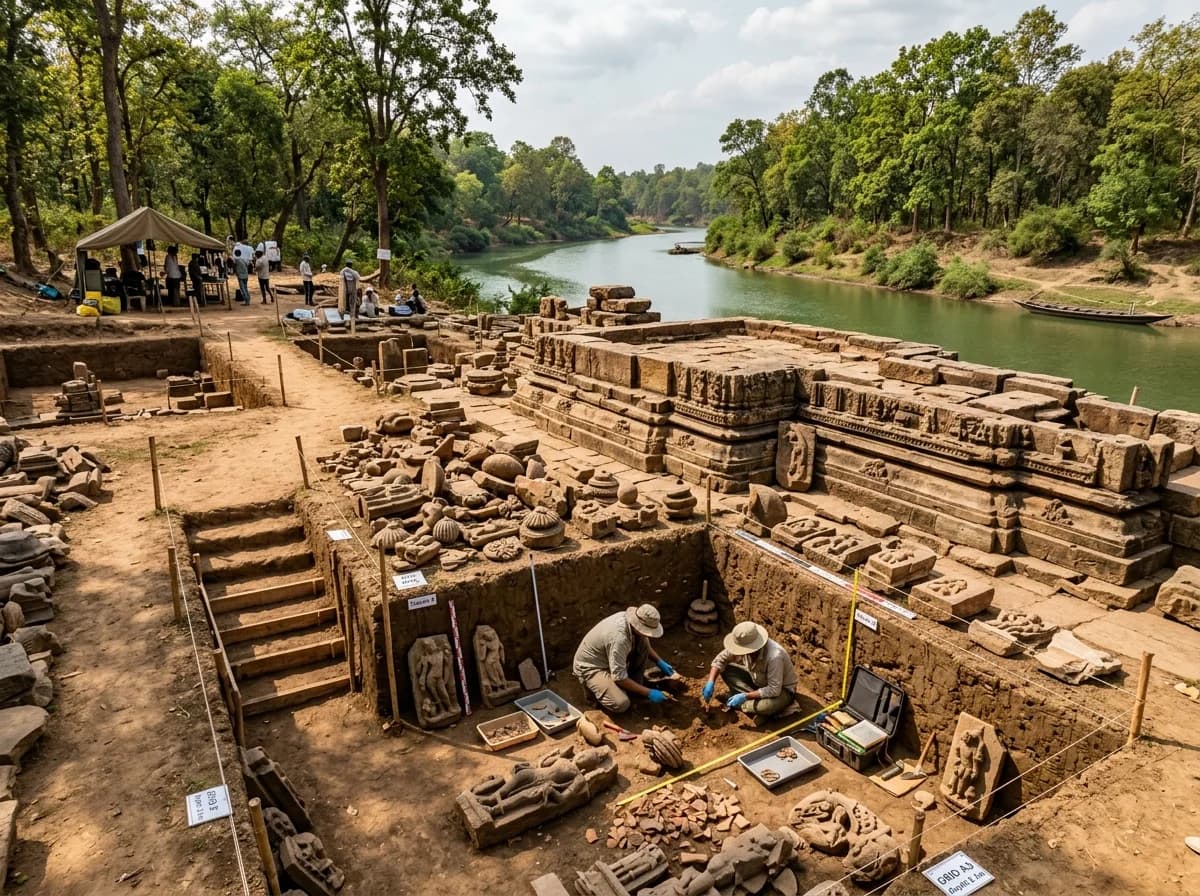
Excavations by the Directorate of Culture & Archaeology revealed that Pachrahi was a fortified township, customs checkpoint, and river trade port that flourished between the 11th and 14th centuries CE.
Key Archaeological Discoveries at Pachrahi
The archaeological trenches excavated across a series of stratified earthen mounds (teelas) bordering the Haph River yielded four monumental categories of discoveries:
1. The 160-Million-Year-Old Jurassic Marine Fossil
Among Pachrahi’s most celebrated non-monumental treasures is a fossilized marine mollusk (gastropod/snail shell) dating to the Jurassic period (approx. 160 million years ago). Found embedded within ancient gravel strata along the Haph River terrace, this specimen offers tangible scientific proof that shallow inland sea arms once reached deep into Central India before tectonic uplift created the Maikal and Satpura ranges.
2. The Kalachuri Royal Coin Hoard
Pachrahi unmasked an extraordinary numismatic hoard consisting of more than 100 gold, silver, and copper coins struck by the illustrious Kalachuri rulers of Ratanpur. Royal inscriptions on the coins honor prominent kings:
- Raja Ratnadeva
- Raja Prithvideva
- Raja Jajalladeva
- Raja Pratapmalla Deva
These coins confirm that Pachrahi had its own active market square, revenue collection bureau, and high-volume commercial circulation connecting eastern Chhattisgarh to the northern kingdoms.
3. Sandstone Temples & Royal Architecture
Excavators unearthed foundational plinths and stone architectural elements of multiple medieval temples designed in the classic Nagara shikhara style:
- Intricately carved door jambs, stone lintels featuring floral scrollwork, and ornate pillars.
- Finely engineered stone water drainage spouts (makara-pranalas) that emptied temple sanctum runoff into the river.
- Foundations of residential structures and a fortified palace plinth indicating royal or administrative residence contemporary with the builders of Bhoramdeo Temple.
4. Multifaith Harmony (Hindu, Jain & Buddhist)
Pachrahi stands out as clear evidence of pluralistic coexistence in medieval Chhattisgarh:
- Shaivite & Vaishnavite: Sculptures of Uma-Maheshwar, Shiva Nataraja, dancing Ganesha, and Vishnu in various avatars.
- Jainism: Beautifully polished statues of Jain Tirthankaras (including Parshvanatha and Rishabhanatha) seated in serene dhyanasana meditation posture.
- Buddhism: Votive terracotta plaques and Buddhist iconography reflecting wandering monastic lineages along the trade routes.
The Pachrahi Site Archaeological Museum
To prevent fragile discoveries from being scattered or damaged, the Government of Chhattisgarh established a dedicated Site Museum directly at Pachrahi:
- What Is on Display:
- Carved stone deities and architectural lintels rescued from the river mounds.
- Ancient iron implements of daily life and defense (spearheads, swords, arrowheads, and medieval iron fetters).
- Semiprecious stone beads carved from agate, chalcedony, and jasper.
- Diagnostic pottery sequences ranging from early historic coarse red ware to fine medieval glazed ceramics.
- Visiting Hours: Open during regular government office hours (10:00 AM – 05:00 PM, Tuesday through Sunday; closed on government holidays).
- Guide & Caretaker: A knowledgeable local caretaker from the archaeology department is typically on site to guide visitors through the exhibits and point out the original excavation trenches.
Travel Tips & Practical Visiting Advice
- Walking & Footwear*: The archaeological complex spans outdoor mounds and grassy riverbanks. Wear comfortable walking shoes or sneakers suitable for dirt tracks and loose gravel.
- Food & Refreshments*: There are no elaborate restaurants at the archaeological site itself. Basic tea and snacks are available in nearby Bodla town. For full meals, head into Kawardha to dine at Shree Anandam Restaurant or roadside eateries like Vicky Dhaba.
- Photography*: Photography is generally permitted across the outdoor excavation mounds. For the indoor museum showcases, check with the on-site caretaker regarding current camera protocols.
- Best Season: Plan your visit between October and March*, when winter temperatures (14°C–26°C) make walking across the open river bluffs comfortable.
The Perfect 1-Day Kabirdham Heritage & Nature Circuit
Visitors can easily tour three of Kabirdham’s greatest highlights in a single, well-planned circuit:
- Morning (08:30 AM – 10:30 AM)*: Explore the intricate 11th-century erotic and spiritual stone carvings at Bhoramdeo Temple and Madwa Mahal.
- Mid-Day (11:15 AM – 01:30 PM)*: Drive 28 km to Rani Dahra Waterfall for a scenic forest walk, views of the 90-foot cascade, and a packed picnic lunch by the stream.
- Afternoon (02:00 PM – 04:00 PM): Drive 18 km onward to Pachrahi Archaeological Site & Museum* to explore the excavation mounds, ancient coin history, and the 160-million-year-old fossil.
- Late Afternoon / Sunset*: Return to Kawardha (45 km) in time to watch the sun set over the waters of Sarodha Dam.
Frequently Asked Questions (FAQ)
Where is Pachrahi archaeological site located?
Pachrahi is located on the right bank of the Haph River in Bodla block of Kabirdham (Kawardha) district, Chhattisgarh. It is roughly 15 km northwest of Bodla town and 45 km north of the district headquarters in Kawardha.
How far is Pachrahi from Raipur and Bilaspur?
- From Raipur: Approximately 170 km via National Highway 30 (through Simga, Bemetara, Kawardha, and Bodla), taking about 3.5 to 4 hours by road.
- From Bilaspur: Approximately 150 km via Mungeli, Pandariya, and Bodla, taking approximately 3.5 hours.
- From Durg / Bhilai: Approximately 165 km via Bemetara or Khairagarh (about 3.5 to 4 hours).
What was discovered at the Pachrahi excavation?
Excavations conducted between 2007 and 2011 by the Chhattisgarh Directorate of Culture & Archaeology unearthed:
- A 160-million-year-old Jurassic marine mollusk fossil.
- Over 100 gold, silver, and copper coins of the Kalachuri kings of Ratanpur (Ratnadeva, Prithvideva, Jajalladeva).
- Plinths of 11th-to-14th-century Nagara-style stone temples and palace structures.
- Sculptures and votive plaques representing Hindu (Shiva, Vishnu), Jain (Tirthankaras), and Buddhist faiths.
- Iron weapons, ancient pottery, and semiprecious stone beads.
What are the timings and entry fees for the Pachrahi Site Museum?
Entry to the open excavation grounds is free. The on-site archaeological museum is open during regular government working hours (typically 10:00 AM to 05:00 PM, closed on Mondays and gazetted government holidays). Entry fee, when charged, is nominal.
Can Pachrahi and Rani Dahra Waterfall be visited on the same day?
Yes! They are located just 18 km apart via Bodla. Visitors typically visit Bhoramdeo Temple and Rani Dahra Waterfall in the morning and early afternoon, followed by Pachrahi Archaeological Site and Museum in the afternoon.
Known For & Highlights
- State-protected archaeological excavation mounds on the natural banks of the Haph River
- Hoard of over 100 gold, silver, and copper coins from the Kalachuri kings of Ratanpur
- Remarkable 160-million-year-old fossilized marine mollusk confirming ancient inland sea waters
- Coexistence of Hindu, Jain, and Buddhist sculptural remains within a unified ancient township
- Dedicated on-site Archaeological Museum displaying excavated weapons, sculptures, and pottery
- Strategic location along the historic trade route linking Dakshin Kosala to the Narmada Valley