
History of Kawardha State: Raj Gond Kings, Princely Heritage & Kabir Panth
Discover the history of Kawardha princely state: founded in 1751 by Thakur Mahabali Singh, Raj Gond dynasty, British treaties, Kawardha Palace, and 1948 accession.
A Quick History Lesson (The Short Version)
| Historical Landmark | Detail |
|---|---|
| Year of Foundation | 1751 CE |
| Founding Ruler | Thakur Mahabali Singh (Mahun Singh) |
| Ruling Dynasty | Raj Gond (Nagavanshi / Gond-Kshatriya lineage) |
| State Classification | 14 Feudatory States of Chhattisgarh (Central Provinces) |
| British Treaties | Early subsidiary relations from 1802; British Feudatory sanad |
| Last Ruling Monarch | Raja Lal Dharamraj Singh (Reigned 1920–1948) |
| Date of Accession | January 1, 1948 (Signed into the Indian Union) |
| Spiritual Legacy | Prominent historical seat (Guru Gaddi) of the Dharamdasi Kabir Panth |
| Living Monuments | Kawardha Palace, Radha Krishna Temple, Sadar Bazaar |
1. Origins & Foundation (1751 CE)
The history of organized rule in the Kawardha valley spans multiple eras. Centuries before Kawardha State was founded, the region flourished under the Phani Nagavanshi dynasty (11th to 14th century CE), who erected the architectural masterpieces of Bhoramdeo Temple, Madwa Mahal, and Cherki Mahal.
Following the decline of the Nagavanshis and the medieval fragmentation of Central India, Thakur Mahabali Singh established the sovereign principality of Kawardha State in 1751.
The ruling family belonged to the Raj Gond lineage, a noble indigenous warrior aristocracy that maintained deep bonds with both tribal Gond communities of the Maikal hills and the Haihayavanshi rulers of Ratanpur. Rulers were initially addressed by the traditional honorific title of Thakur, and later formally recognized with the royal title of Raja.
2. The Maratha & British Colonial Period
The Bhonsle Maratha Sphere
During the mid-18th century, the Bhonsles of Nagpur expanded their sovereignty across Dakshin Kosala (Chhattisgarh). Kawardha, situated strategically along the mountain highway connecting Jabalpur to the fertile Mahanadi plains, functioned as a semi-autonomous tributary state, paying regular tribute (tanka) to the Maratha governors seated in Raipur and Ratanpur.
British Subsidiary Alliance & Feudatory Status
Following the Third Anglo-Maratha War in 1818, the British East India Company assumed political supremacy over the Nagpur territories. In 1854, the Nagpur province lapsed to the British Crown.
- Kawardha was formally designated as one of the 14 Feudatory States of Chhattisgarh under the administration of the Central Provinces and Berar.
- Under British paramountcy, the internal civil administration, judicial authority, and revenue collection remained in the hands of the ruling Thakurs.
- In 1933, administrative oversight of Kawardha was transferred from the Central Provinces to the newly constituted Eastern States Agency.
3. The Reign of Raja Lal Dharamraj Singh (1920–1948)
The most transformative modern period of Kawardha State occurred under the reign of Raja Lal Dharamraj Singh, who ascended the gaddi in 1920.
The Construction of Kawardha Palace (1930s)
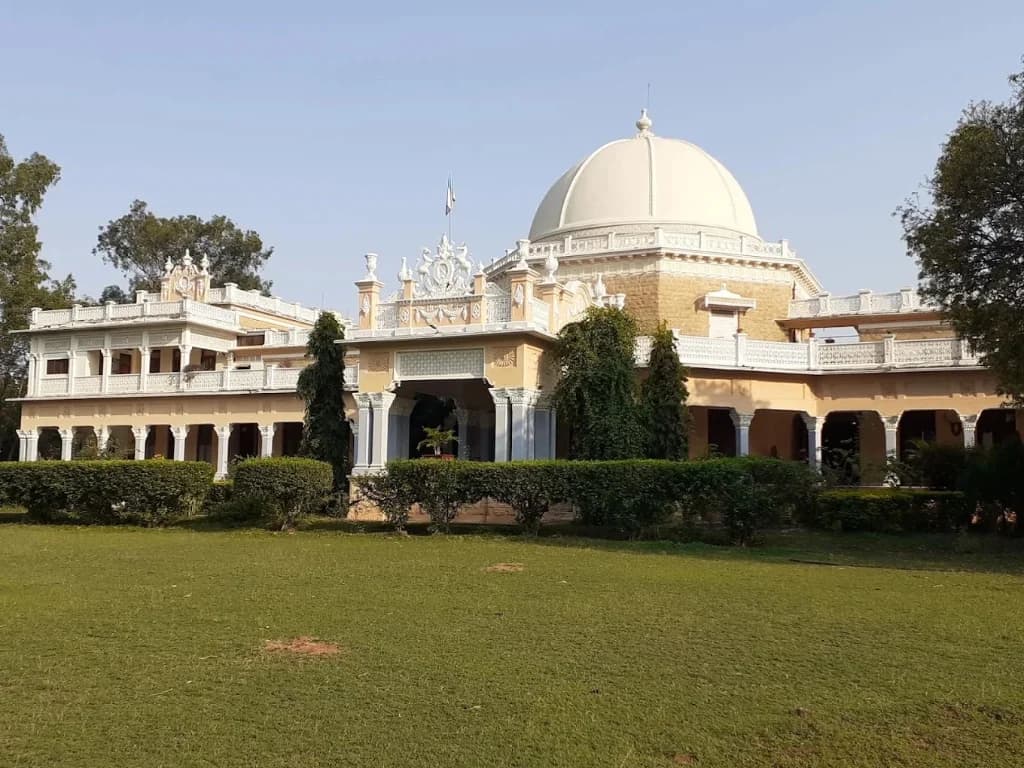
Raja Lal Dharamraj Singh was an enlightened builder with an eye for refined architecture. In the mid-1930s, he commissioned the construction of Kawardha Palace, an elegant mansion designed by colonial and Indian master-masons:
- Constructed using locally quarried Italian marble, pink sandstone, and teakwood.
- Features stately Corinthian colonnades, wide sun-shaded verandahs, intricate stone jali screens, and tranquil royal gardens.
- The palace remains one of the finest preserved architectural landmarks of Central Indian princely heritage.
Civic Infrastructure & Modernization
During his reign:
- Kawardha established its first modern schools and public health dispensaries.
- Improved agricultural canals tapped the waters of the Sakri river.
- Sadar Bazaar was expanded, offering organized patronage to local bell-metal craftsmen and Kosa silk handloom weavers.
4. The Spiritual Anchor: Kawardha & The Kabir Panth
No account of Kawardha’s history is complete without understanding its sacred association with the Kabir Panth:
- Dhani Dharamdas: A wealthy merchant from Bandhavgarh, Sant Dharamdas became the foremost disciple of Saint Kabir Saheb in the 15th century and founded the Dharamdasi lineage of the sect.
- The Seat at Kawardha: For over a century, Kawardha served as the official seat of the reigning Acharya (Guru Gaddi) of the Dharamdasi Kabir Panthis before expanding to nearby Damakheda.
- Cultural Impact: The principles of simplicity, vegetarianism, inter-community harmony, and non-violence preached by the Kabir Panth deeply influenced Kawardha’s social fabric.
- Naming of Kabirdham: Recognizing this profound legacy, the Government of Chhattisgarh officially renamed the district from Kawardha to Kabirdham in 2003.
5. Integration into Modern India (1948)
Following Indian Independence in August 1947, the process of integrating the 565 princely states into the Indian Union was led by Sardar Vallabhbhai Patel and V.P. Menon.
On January 1, 1948, Raja Lal Dharamraj Singh signed the Instrument of Accession, peacefully merging Kawardha State into the Central Provinces and Berar of the newly independent Dominion of India.
- Following state reorganization in 1956, Kawardha became part of Madhya Pradesh (under Bilaspur and later Rajnandgaon district).
- On July 6, 1998, the region was officially carved out as an independent district (initially named Kawardha District, later Kabirdham).
- On November 1, 2000, with the creation of the new state of Chhattisgarh, Kawardha became a foundational western district of the new state.
6. Living Heritage You Can Visit Today
Visitors to Kawardha can trace this layered royal and spiritual history through several accessible landmarks:
- *Kawardha Palace: Located in the heart of the city, the palace stands as a living reminder of 1930s princely craftsmanship.
- *Radha Krishna Temple: Commissioned by the royal house, featuring sacred underground spring waters (baoli).
- *Panchmukhi Budha Mahadev Mandir: Ancient town shrine patronized by both royal rulers and local townsfolk.
- Sadar Bazaar*: Historic royal market quarter where centuries-old artisan traditions of bell-metal and Kosa silk handlooms still thrive.
- *Bhoramdeo Temple Complex: The 11th-century Nagavanshi cradle located 18 km west, connecting Kawardha's princely lineage to medieval dynasties.
Frequently Asked Questions
When was Kawardha State established?
Kawardha State was founded in 1751 CE by Thakur Mahabali Singh, a noble of the Raj Gond dynasty.
Who was the last ruling king of Kawardha?
The last ruling monarch of Kawardha was Raja Lal Dharamraj Singh, who ruled from 1920 until the state's formal accession to the Indian Union on January 1, 1948.
Why was Kawardha renamed Kabirdham?
Kawardha was historically a major spiritual center and seat of the Dharamdasi branch of the Kabir Panth. In 2003, the Government of Chhattisgarh renamed the district Kabirdham in honor of Saint Kabir Saheb. Kawardha remains the name of the district's capital city.
Can tourists visit Kawardha Palace?
Kawardha Palace is partly a private royal residence and partly operated as an exclusive heritage retreat. Visitors can admire the external architecture and lawns, while interior access is typically available for guests staying at the heritage suites or through prior permission.